Pediatric Dentist vs. General Dentist: What Woodland Hills Parents Should Know
Pediatric dentist vs general dentist: which is right for your child in Woodland Hills? Learn the key differences and book your family's visit today!
Read More



General Dentistry
Both general and pediatric dentists can treat children, but pediatric specialists bring extra training, child-specific equipment, and sedation capabilities that matter most for anxious kids or complex cases. Understanding the real differences helps you make the right call for your family.
Here's a fact that catches many families off guard: the American Academy of Pediatric Dentistry recommends a child's first dental visit within six months of the first tooth appearing — and no later than the first birthday.
Yet many general dentists decline to see patients under age three. Why? Because examining a pre-verbal, non-cooperative infant requires specific equipment and a technique called the knee-to-knee exam. The parent and provider sit facing each other, knee-to-knee, with the infant lying across both laps. This position lets the clinician safely examine the mouth while the parent helps stabilize the child — something most general dental chairs simply aren't designed to support.
During this infant exam, a kids dentist pediatric dentistry specialist also performs an early childhood caries (ECC) risk assessment, evaluating feeding habits, fluoride exposure, and bacterial risk factors. They assess non-nutritive sucking habits — pacifier use and thumb-sucking — for early skeletal impact on the developing jaw and bite. General dentists routinely defer these evaluations until the toddler years, which can mean missed windows for early intervention.
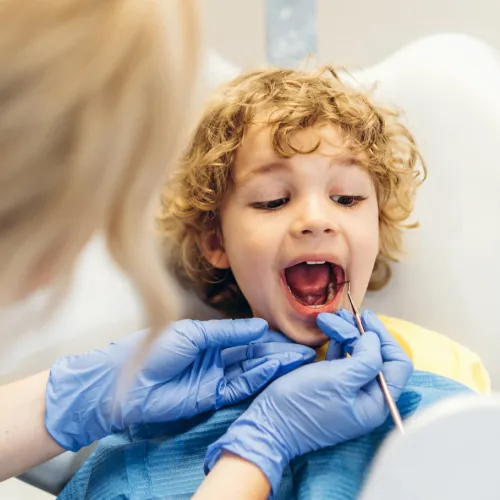
As MouthHealthy notes, if a child would benefit from pediatric dental care for health or behavioral reasons — or would simply feel more comfortable in an environment designed for children — a pediatric dentist is an excellent option. That environment matters: bright colors, child-scaled equipment, and waiting rooms stocked with toys aren't just aesthetic choices. They're clinical tools for reducing anxiety.
When a child needs extensive treatment — multiple pulpotomies, surgical extractions, or restorations across several teeth — sedation becomes a real conversation. This is where the difference between provider types becomes clinically significant, and where parents are often surprised.
Most general dentists can offer nitrous oxide (laughing gas), which provides mild relaxation. Some hold permits for oral conscious sedation, which produces deeper relaxation while the child remains awake. These are appropriate for mild-to-moderate anxiety.
Pediatric dentists, by contrast, frequently hold PALS (Pediatric Advanced Life Support) certification and may maintain hospital admitting privileges — qualifications that allow them to coordinate hospital-based general anesthesia for cases where a child cannot safely complete treatment in-office. According to WebMD, pediatric dental training specifically encompasses care for anxious children and patients with special needs, which directly informs these advanced sedation capabilities.
The four clinical levels break down like this:
If your child's treatment plan is extensive, asking specifically about sedation credentials and hospital access is a reasonable and important question. In some cases, a toothache emergency dentist may also need to be involved when acute pain or infection requires urgent attention alongside sedation planning.
General and family dentists are absolutely qualified to provide dental cleaning services for children's teeth, apply fluoride, diagnose cavities, and manage routine care. Delta Dental confirms that both accredited general and pediatric dentists have the training to offer a high level of care to children. If your family already has a trusted general dentist, that relationship has real value.
Where parents sometimes encounter unexpected billing is in the pediatric specialty setting. Standard preventive codes — like a child prophylaxis cleaning — are commonly covered by insurance. But pediatric offices may also bill for behavior management services (CDT code D9920) when additional provider time and techniques are needed to complete treatment with an uncooperative child. Protective stabilization may carry its own separate code. These charges are frequently not covered by standard dental insurance plans, which can create surprise out-of-pocket expenses.
This isn't a reason to avoid pediatric dentists — for children who genuinely need behavioral support, these services are clinically justified. But it's worth asking any specialist office which codes they routinely bill and how those map to your plan's coverage before the appointment.
As WebMD explains, cavity fillings and tooth decay represent the most common chronic disease in children — more prevalent than asthma — yet largely preventable. Whether you choose a general or pediatric dentist, consistent, early care is what moves the needle most.
For healthy children with routine needs and a cooperative temperament, a skilled family dentist can absolutely serve them well. For infants under one, anxious children, kids with special health care needs, or those facing complex procedures, a pediatric specialist's additional two-plus years of focused training — in child psychology, growth and development, and advanced sedation — makes a meaningful clinical difference.
The right answer depends on your child's specific needs, not a universal rule. If your child is also experiencing issues like gum disease gingivitis, early intervention by the right provider can prevent more serious complications down the road.
Complete Health Dentistry serves families throughout Woodland Hills and the West San Fernando Valley. If you have questions about your child's dental care — whether that means connecting with our team or understanding what kind of specialist your child may need — we're here to help you navigate those decisions with confidence. Reach out to schedule a conversation.
Medical disclaimer: This article is for informational purposes only and does not constitute dental or medical advice. Always consult a licensed dental professional regarding your child's specific oral health needs.