Invisalign Attachments, SmartTrack Material, and Why 22 Hours Is Non-Negotiable
Learn how Invisalign attachments, SmartTrack material, and the 22-hour wear rule create your best smile. Schedule your Invisalign consultation today!
Read More



General Dentistry
A dental cleaning, an exam, and a deep scaling are three clinically distinct procedures — each with its own billing code, provider, and purpose. Understanding the difference helps you avoid surprise bills and know exactly what your hygienist and dentist are each responsible for doing.
For Woodland Hills-area patients, you scheduled a "checkup." You expected one charge. Then the explanation of benefits arrives showing three separate line items — a cleaning, a periodic exam, and X-rays — each reimbursed at a different percentage.
This isn't a billing error. It reflects how dental care is actually structured.
The American Dental Association assigns every procedure a specific CDT code. A routine adult dental cleaning is billed as D1110 (prophylaxis). Your periodic exam is D0120. If your hygienist determines you need a deeper clean below the gumline, that becomes D4341 or D4342 — scaling and root planing, charged per quadrant.
Why does this matter? Because your insurance plan may cover cleanings every six months but restrict exams to once per calendar year. If your cleaning and exam fall on a date your plan considers "too soon" for the exam, you absorb that fee entirely out of pocket.
The fix is straightforward: before your appointment, call your insurance provider and confirm that your D1110, D0120, and any anticipated X-ray codes are all within their covered frequency window on the same date. As WebMD explains, dental checkups and dental treatments are scheduled and billed on entirely different tracks — conflating them is where most patient confusion begins.
Many patients feel shortchanged when a hygienist spends 45 minutes on their teeth, then the dentist appears for two minutes, nods, and leaves — yet both generate separate charges.
Here's the clinical reason that structure exists.
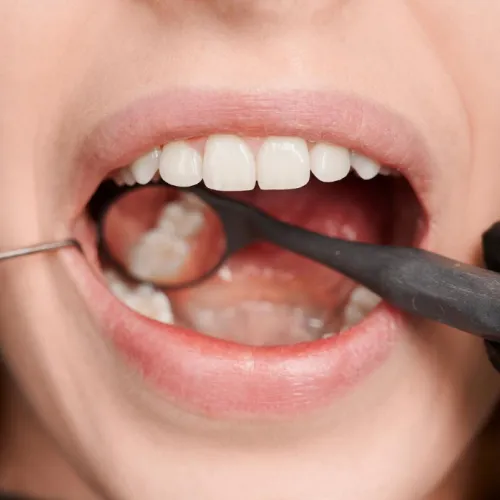
Dental hygienists are licensed preventive specialists. Their scope covers removing plaque, calculus, and staining; performing pocket depth measurements; and providing oral hygiene education. According to a Healthline overview, a hygienist begins every appointment with a physical exam of the mouth using a small mirror, checking for signs of gingivitis before any instrumentation begins.
What hygienists cannot legally do: diagnose disease, prescribe medication, or design a treatment plan. That legal boundary is why the dentist's rapid exam isn't optional — it's a distinct diagnostic act. In those two minutes, the dentist is screening for oral cancer, assessing TMJ jaw pain function, evaluating bite changes, and interpreting radiographic findings. These are diagnostic determinations a hygienist is not licensed to officially make.
So the cleaning and the exam are not redundant. They are performed by two different licensed professionals operating within separate legal scopes — which is exactly why they appear as two separate CDT codes on your bill.
This is where patients feel most vulnerable to being "upsold." You came in expecting a routine cleaning and left with a recommendation for scaling and root planing at a significantly higher cost. How do you know if that recommendation is warranted?
Listen for the numbers your hygienist calls out during the exam. Those are periodontal pocket depths, measured in millimeters using a probe.
Here's what they mean clinically:
The NIDCR confirms that pockets exceeding healthy depth allow plaque to accumulate where brushing cannot reach, eventually destroying the bone that supports your teeth.
If you want to verify the recommendation yourself, ask your dentist to pull up your digital X-rays alongside your charted pocket numbers. Bone loss visible on radiographs alongside pocket depths of 5 mm or greater is objective clinical evidence — not a sales pitch. If the X-rays show no bone loss and your pockets are mostly 3 mm or under, a routine cleaning is the appropriate treatment. Mouthhealthy.org notes that scaling and root planing is specifically indicated for chronic periodontitis, not for healthy patients with minor buildup. If gingivitis gum disease is confirmed, your provider will outline a treatment plan based on the severity of your condition.
No — and conflating them creates both clinical and financial problems.
A checkup (the exam) is a diagnostic event. The dentist evaluates your overall oral health, screens for pathology, reviews your medical history, and determines what treatment — if any — you need. As the ADA's guidance on home oral care makes clear, the dentist's role includes designing individualized care regimens based on each patient's specific disease risk.
A cleaning (prophylaxis) is a preventive treatment. It removes the bacterial buildup that daily brushing cannot eliminate, particularly hardened tartar that only professional instrumentation can address.
Deep scaling is a therapeutic treatment for active gum disease — not a more thorough version of a cleaning. It goes below the gumline to disrupt bacterial colonies in periodontal pockets and is typically completed across multiple appointments. In some cases, when decay has progressed significantly, treatments such as cavity fillings for tooth decay or more advanced restorative work may also be recommended alongside periodontal therapy.
These three services are related but not interchangeable. Receiving a cleaning without an exam means no one has diagnosed whether that cleaning is sufficient. Receiving an exam without a cleaning means the preventive work isn't done. Understanding this distinction helps you arrive at appointments knowing what to expect — and knowing what questions to ask.
If you're overdue for a visit — or unsure whether you need a routine cleaning or something more — Complete Health Dentistry in Woodland Hills is here to give you a straight answer. Serving the West San Fernando Valley including Calabasas, our cosmetic dentist in Woodland Hills team will walk you through your pocket depth chart, explain your X-ray findings, and help you understand exactly what's recommended and why before any treatment begins. Contact us to schedule your appointment.
This article is for informational purposes only and does not constitute dental or medical advice. Always consult a licensed dental professional for diagnosis and treatment recommendations specific to your oral health.